I loved being a Boy Scout growing up. I cherished the summer barbeques, the roasted marshmallows over firepits, the camping under twilight stars. Mind you, I wasn’t the best Boy Scout – the best Boy Scouts would read the scout handbook and earn merit badge after merit badge, climbing the ranks. Even so, the Boy Scout values rubbed off on me. The reverence of doing what is right, of virtue, was weaved into many aspects of being a Boy Scout.
When camping, after a wonderfully activious weekend in the woods, we’d move with a tired haste to pack our tents, hop in our cars and return home. But before we could leave, we’d have to comb through the campsite in rows, picking up trash whether it was ours or others – because we were taught to always "Leave it better than you found it". Over time I’d learned to admire the beauty in that simple philosophy.
It started affecting how I felt about the world. I’ve been given such an wonderfully exciting life in such a beautiful world that by the time I’ve completed my trip, I’d like to have left it better than I found it. I’d like to leave my own positive dent in the universe. As I felt an intensifying yearning to do so, I began considering the various ways I could maximize my positive impact.
In school, I thought my impact could be furthering the frontier of human knowledge through academic research and a PhD. Then as a machine learning engineer, I considered saving lives through preventing mosquito-born illnesses or car crashes. I learned a lot from the latter role, but I found that I struggled with motivation as often I didn’t have the agency to make effective decisions in order to maximize impact. I felt as if my potential for impact was greater, if I had more agency to make more decisions. I knew I could learn more by doing, especially as I started playing with my first startup.
Things really clicked there, where despite our innumerable mistakes, we clearly had changed the world by many orders of magnitude more than any role I had at Google or Waymo. By founding my own company, it felt like I could start putting a dent in the universe, but I still felt unsatisfied on if it was a positive dent. I didn’t want to do something high-impact but not positive, and I didn’t want to do something positive that barely mattered. The leading question is: What is a framework that can help represent these properteries of high-magnitude positive impact?
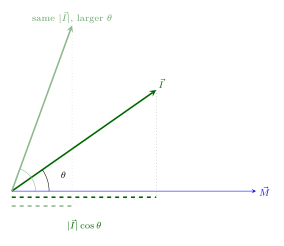
We can steal from math an awfully useful framework – the vector. Vectors are defined by their size and direction, the same qualities needed to quantify impact dents. Let’s imagine an impact vector \(\vec{I}\) representing one’s effect on the world. Ideally it should be big enough to matter and pointed in a positive direction.
What defines a "positive direction"? This seems a bit personal, dependent on an individual’s specific set of moral values. Perhaps in the same space we defined our impact vector we can define some moral vector \(\vec{M}\) which just defines their "positive direction", and whose magnitude doesn’t really matter.1
\[\text{Example } \vec{M} := \begin{pmatrix} \text{socioeconomic equality: } 0.62 \\ \text{increasing median lifespan: } 0.77 \\ \text{climate preservation: } 0.15 \end{pmatrix}\]
These vectors can be fun to play with. We get along with people with very similar moral values \(\vec{M}\), which are our nearest neighbors in the vector space. People could sit on the negative side of certain axes of the moral vector space. In fact there could be people who would have moral vectors that point in very opposite directions and they’d likely fiercely oppose each other on many issues.2
One’s goal in life, assuming they care about their impact, is to nudge the world in the direction of the moral vector. If I cared a ton about increasing the median lifespan, then I should probably work in healthcare or longevity, so I can push the world in the direction of my moral vector. And depending on how much I care, I want to push the world as much as my life’s potential would allow. Perhaps I’d directly save lives as an EMT, or I’d do oncology research as an MD-PhD, or I’d reform health insurance for equity in policy.
\[\vec{W}_{t+1} = \vec{W}_{t} + \vec{i}(t)\]
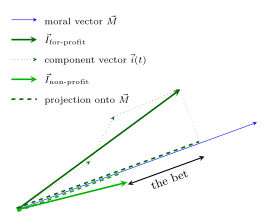
I care quite a bit about my moral vector, and have been given enough privilege and agency4 to set a life goal to shove the world as far in the direction of my moral vector as possible. I can now imagine that I have two paths in front of me each with their own hypothetical impact vectors \(\vec{I}_{\text{for-profit}}\) and \(\vec{I}_{\text{non-profit}}\). In order to best evaluate each option, I want to measure how far each pushes the world in the direction of my moral vector.
We can steal from math once again for another awfully useful measurement tool – the dot product. Dot products are defined by how big vectors are and how closely they point to each other. In the case of our moral and impact vectors, if \(\vec{I}\) strays from \(\vec{M}\) then the dot product gets smaller, and vice versa.
Another way of thinking about dot products is to look at the "shadow"6 that \(\vec{I}\) casts on \(\vec{M}\). This helps give a physical intuition to the magnitude part of dot products – the size of the impact vector \(\vec{I}\) matters too – a bigger dent casts a greater shadow on the moral vector \(\vec{M}\).
I’d like to maximize my \(\vec{I}\cdot\vec{M}\), so that by the time I die, my dents and nudges on the world should have moved it as far as possible in the direction of my moral vector.
I can now apply this framework to evaluate for-profit vs. non-profit companies. A non-profit, which would likely be quite aligned with my moral vector (low \(\theta\)). But the magnitude \(|\vec{I}_{\text{non-profit}}|\) typically depends on the funding that non-profits receives, which is directly proportional to the number of rich people and non-profit organizations I can convince to give me money – linear scaling.
The appealing alternative is the for-profit company – the darling of our capitalist world. And for good reason – the magnitude of the impact vectors on these puppies are astronomical. If I can get the flywheel going on a for-profit company, its growth and impact magnitudes are exponential, not linear, so \(|\vec{I}_{\text{for-profit}}| \;>\; |\vec{I}_{\text{non-profit}}|\).
\[\text{Hypothesis:}\qquad \vec{I}_{\text{non-profit}}\cdot \vec{M} \;<\; \vec{I}_{\text{for-profit}}\cdot \vec{M}\]
So the problem then becomes, how aligned \(\vec{I}_{\text{for-profit}}\) with my moral vector \(\vec{M}\). As the company succeeds and the magnitude of the vector scales, does its alignment veer further away? Impact vectors aren’t static – they can change over time. As they wiggle and waggle over time, their effects could drift from my original intention.

If I want to ride the wild-ride of building a for-profit company, particularly a VC-backed startup, then it matters a ton to make sure I steer that ship towards my moral vector. The consequences are higher – as the startup becomes successful, its impact on the world becomes larger and larger (\(|\vec{i}_{t+1}|>|\vec{i}_{t}|\)). What if it begins careening away from my moral vector, orthogonal to \(\vec{M}\) – or worse, backwards, a negative dot product, where the enormous magnitude I’ve built works against my values. It seems important to measure then its alignment with my moral vector constantly, to ensure my impact is pointed in the right direction.
\[\cos\theta(t) \;=\; \frac{\vec{M}\cdot\vec{i}(t)}{|\vec{i}(t)|}\]
We can pilfer math a final time for one last measurement tool – cosine distance. This is the alignment component of the dot product, the angle between the moral and impact vectors. And if the cosine distance stays sufficiently close, even if it’s further than the nonprofit would be, the projection of \(\vec{I}_\text{for-profit}\) onto \(\vec{M}\) would still be higher than \(\vec{I}_\text{non-profit}\) onto \(\vec{M}\). That is really appealing… and I’m greedy. So I bet on \(\vec{I}_\text{for-profit}\), while keeping a close eye on cosine distance \(\theta\).
This is all-natural, organic human thought. I did use, however, Opus/Fable to generate the TikZ diagrams and debug LaTeX syntax. Thank you to Simon Fong for reading draft 3 and Julie Kunnumpurath for reading draft 4. Thank you to Thalia Cadiz for our talks about alignment.
In math we lazily use 1 for magnitude and call this a unit vector.↩︎
You could measure how aligned people’s morals are with cosine distance.↩︎
Summed over everyone, the world’s motion is \(\frac{d\vec{W}}{dt} = \sum_{p=1}^{8.3\times10^{9}} \vec{i}_p(t)\).↩︎
Thanks Ma and Baba ❤↩︎
Recall we made the moral vector a unit vector, so \(|\vec{M}| = 1\) and it drops out of the product.↩︎
In linear algebra we call this a projection.↩︎